
Burn, Uncle Ted
Theodore McCarrick never acknowledged his crimes

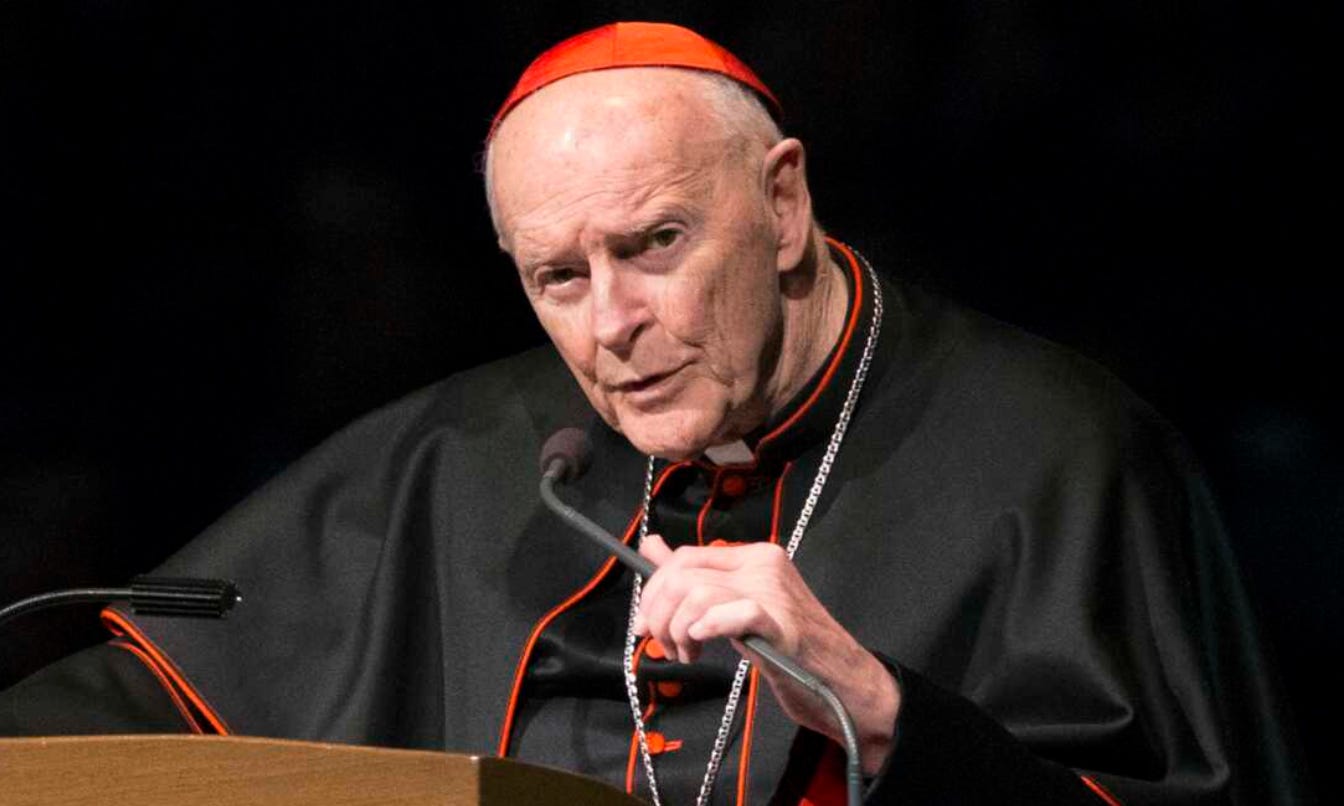
Lavender Don and boy-rapist Theodore McCarrick is dead. His American cardinal cronies, not yet.
A fellow Catholic and friend, in a thread under a piece on the rapist’s passing, put it this way: “It sure is gracious of them to wear scarlet garb as a warning to the rest of us.”
A pitch-perfect comment on what the red has come to represent under our current pope.
My own mood was less joking. I pointed out that St. Peter Damian, in his 11th-century treatise Gomorrah, had favorably cited an ecclesiastical law on how such men should be dealt with. The law required that any cleric caught sexually abusing a boy or adolescent be first publicly humiliated, then bound in chains and imprisoned in a monastic cell, where he’d be required to fast on barley bread for months. After which he’d be permanently placed under the custody of two other monks who’d ensure that he never had access to children again.
This is literally, as in “Do it step by step and I mean ONLY barley bread and water,” what should happen to these men.
The Vatican is not a liberal democracy. Certainly they’ve enough space for cells to hold clerical child abusers until the Lord takes them. Instead what did they do?
When McCarrick returned to the Vatican, it was in his red garb. And at the invitation of the pope.
You know the pope I mean. The one who years ago became famous for saying: “Who am I to judge?”
That was at the beginning of his papacy, and Catholics clearly didn’t understand his actual meaning. They misheard the stress. They assumed he was saying something like: “As Christians, all of us are sinful. Who am I to judge another Christian?”
We’d only learn his real meaning later, as the years passed. Something like: “As the Vicar of Christ, the man chosen pope has grave responsibility to guide the faithful and protect the deposit of faith. To do so, he must exercise wisdom in judgment. Who am I to hold this position? I’m just a chatty Boomer hippy.”
In other words, it’s not that the Vicar of Christ is not in a position to judge. But rather: “Who am I to judge?”
My friend in that thread later on argued that the celibate priesthood is a bad idea, as it “selects for perverts.” I think that exaggerates the case somewhat, but contains a kernel of truth.
My argument was that it was true, in a way, but not always so. With the rise of modernity, yes, the celibate priesthood would tend to select for perverts. But the social dynamics of the centuries before the modern era were different.
Other thing is, as I suppose you know, abuse of children is no more common in Catholic institutions than in other institutions. Public, Protestant--all have abuse of children. During the last decades of the 20th century, abuse rates were somewhat higher in American public schools than in Catholic schools. Which is not saying much.
The Catholic difference was the abuse particularly of boys. The numbers were really telling. Abusers all male, abused nearly all male.
Gee I wonder why there isn't a word for that?
The crime data is available, and what it tells is not what the media wanted it to tell. Thus the nonstop claim that the Catholic problem was pedophilia, a particular sexual disorder.
The data for the US and Europe show this claim to be patently false. It was overwhelmingly boys who were abused, and most of the boys abused were not young children (i.e. pedophilia) but adolescents and teens.
How this happened to the Catholic Church is no mystery. One has to think back to Catholic culture of the mid-20th century. Young men growing up in that culture, realizing they were attracted to males, what options did they have? They couldn’t come out. Yet they weren’t suited for marriage. Their Catholic families, their parents and all the relatives, would be ever pestering: "Why don't you find a girl and get married, John?" The Church was an escape from this.
Which is not to say that Catholic priests from that era are not good priests. Most of them were not men of this type. They made a serious commitment to serve the Lord, and were loyal to their vows. Of course. But all you need is an overrepresentation of men who fit the profile. If only 10 out of 100 fit, you already have a problem. Because they are not entering the priesthood as a calling, but as an escape.
The second problem, of course, was the bishops’ betrayal. The bishops who engaged in cover up. Doubtless some of them were abusers themselves. But many were just trying to protect the Church’s image.
The article that alerted me to McCarrick’s death was by the Orthodox journalist Rod Dreher. It’s a wrenching article, as Dreher himself left the Catholic Church because of the behavior of bishops. He’d at one time been on the cusp of revealing Uncle Ted’s double life in print, but couldn’t, because none of his sources would go on record. What he saw pushed him away from Rome, but didn’t weaken his faith in Christ. Thankfully.
Why didn’t bishops face the problem head on, to root it out? The era was partly to blame.
All evidence suggests that the 1970s were especially bad. Surprise surprise. Just as Vatican II began to be interpreted in terms of “the spirit of Vatican II.” And meanwhile the sexual revolution was spreading through society.
Those problematic young men who opted for the priesthood proceeded to move up the Church ladder. Which is easier when you have Kompromat on others around you.
Result? We have the Church of the present. A Church overseen by an aging clique of greasy frauds. Protectors and apologists for abusers. Men ever curious about and affirming the disorders on offer from the mainstream left. A “listening Church,” which means: “Listening to anyone except faithful Catholics.”
We pray for it to end, but sadly, Uncle Ted’s cronies and peers have been elevated to the College of Cardinals by a pope that Uncle Ted himself helped place on the throne.
I’ll conclude by posting a debate with a priest and canonist from 2019. It presents my case on the evident meaning of the data, and also our culture’s go-to gestures when trying to make that case disappear. Rereading it, two things strike me. First, the utterly ideological shabbiness of the explanations foisted on the public by “experts,” the Church, and media. Second, my own capacity for politeness in the face of this shabbiness. I’m not sure I’d be able to muster it now.
I’ll call this archive:
The Great Rainbow Deflection
Years ago, when I was still on Facebook, I moderated a closed Catholic group dedicated to understanding and exposing the lavender tumor that had metastasized in our Church. I’d often end up discussing our group in other Catholic groups on Facebook, left-leaning ones included, and on one occasion a priest and canonist weighed in to argue that that name we’d chosen, “Catholics United Against the Lavender Mafia,” was somehow offensive.
I knew such pushback was inevitable, because wide swaths of the Catholic faithful were then studiously committed to not seeing what the data on the crisis revealed, even as they were cravenly committed to that 21st-century Rule of Rules--Whatever happens, never never offend the rainbow people.
The whole thing sickened me then, but sickens me more now. Perhaps because I’ve seen more in the interim. From the culture, from the Vatican.
Below is the dialogue that ensued between myself and that priest who joined in to “clear things up.” At issue was whether or not the data in the 2004 John Jay Report on clerical sex abuse indicated a pattern of homosexual men preying on male youths.
I’ve lightly modified the priest’s comments so as to protect his identity. Not because there’s anything embarrassing in what he writes, but he may not want to be challenged on this or that by others who read my blog. The thread in which our dialogue occurred was semi-public.
Father B. writes:
I’m a Roman Catholic priest, ordained in 1995 for the Archdiocese of H-----. After being sent for my canon law degree, I returned to Archdiocese of H----- just before the sexual crisis unfolded in our area. (I was spit upon in public while Christmas shopping because I was in the Roman collar.) I also soon became the primary canonist working on sex abuse cases. I learned things that no one should have to learn--much less endure; it was almost unbearable. My experience in the canonical prosecution of these cases is congruent with the conclusion of the “John Jay Study.”
The John Jay Study stated: “There has been widespread speculation that homosexual identity is linked to the sexual abuse of minors by priests, largely because of the high number of male victims identified in the Nature and Scope study. However, the clinical data do not support this finding. Treatment data show that priests who identified as homosexual, as well as those who participated in same-sex sexual behavior prior to ordination (regardless of sexual identity), were not significantly more likely to abuse minors than priests who identified as heterosexual” (The Causes and Context of Sexual Abuse of Minors by Catholic Priests in the United States, p. 74).
I understand it’s difficult to comprehend. However, sexual predation is not the equivalent of sexual attraction; please keep in mind that it is a mental illness. We often say the predator is “attracted to” but that’s somewhat misleading because they are not attracted to the person. The pedophile doesn’t want a relationship with the victim; once the child physically develops, the “attraction” ends. It’s more like an age-fetish. It’s why pedophiles often have multiple victims.
It’s true that the abuse includes a sexual release, but it is rooted in the perpetrator’s mental illness (self-esteem, rage, powerlessness, etc.). It is turned inwards. The journal of the California priest-abuser is chilling; he seems completely unaware that any of the children would not want to be abused.
In addition, the abuse often involves the victimization of those to which the abuser has access. This is why it isn’t difficult to find married men who abuse young boys, or why pedophiles often abuse boys and girls. More often than not, abusive priests had access to boys--as coaches or servers.
I fear that attempts to hang the sex abuse crisis on some “lavender mafia” or homosexuals or even clerical celibacy are misguided. To properly treat an illness, it absolutely necessary that it be properly diagnosed. The notion--which is understandable but mistaken--that homosexual identity is linked to the sexual abuse of minors is a red herring. The pursuit will be self-affirming but do little to serve the good of victims or the Church.
My Response (to Fr. B. and others in the thread):
As I’ve spent some time on this, and as I seek honest and direct discussion of difficult issues rather than easy soundbites, I hope those who’ve weighed in here will take time to consider my response to Father B.’s comments. I thank him for offering such careful and detailed remarks. His reading of the sex abuse crisis is more or less the established one.
I myself, however, believe this reading suffers certain fatal blind spots and that it is mainly weakened by what are obvious (clinical, social) ideological reframings of the basics of sexual behavior.
So I intend to make a substantial claim, and need to provide a substantially different analysis if I’m to make the claim coherent. Which is why this comment will be a lengthy one by this thread’s standards. I hope people here will bear with me.
1.
Though I’m responding, as I say, to an established analysis, I submit that the burden of proof still lies with those who want to separate the horrors of clerical sex abuse from the sexual orientation of the abusers. In short, I remain convinced that doing so is intellectually bogus and ultimately a deflection.
Again, we are looking at a situation in which the sexual aggressors are 100% male and the victims are, staggeringly, 81% male. Which does not conform to patterns of minor abuse in other social settings, such as public schools, where the data show it is girls who are more often victimized. Why is the gender distribution so markedly skewed toward male victims in our Church? Those promoting the established analysis cannot really answer this.
Let me begin by a clarification of terms which may seem obvious but which is still necessary. Homosexual is the first term. It fundamentally refers to sexual behavior between those of the same (homo) sex. The 81% of documented abuse cases in our Church are thus already homosexual by definition. Yet, again, the establishment analysis repeatedly insists that homosexual “orientation” in the abusers should not (or rather must not) be seen as related to the pattern of the abuse.
I submit that this is a monumental deflection, and that the deflection is possible on the basis of two ideological claims. Since in this attempt to obfuscate, the homo half of the equation can’t be denied (81% of the cases involve male-on-male acts) so instead, in my reading, the sexual half is taken up and a claim is made something along the lines of: “But it’s not real sexuality.”
Briefly, we are told the abusive behavior is not actually sexual because of two supposedly mitigating factors: 1) the cases involve a kind of aggression; 2) the cases are examples of pathology.
I will take them one by one.
2. On “Relationships”
Let’s first note Fr. B.’s own words in his comments: “I understand it’s difficult to comprehend. However, sexual predation is not the equivalent of sexual attraction; please keep in mind that it is a mental illness. We often say the predator is ‘attracted to’ but that’s somewhat misleading because they are not attracted to the person. The pedophile doesn’t want a relationship with the victim….”
There is an absurd ideological claim lurking in your words here, Father. Namely, that real sexual attraction must involve a desire for a “relationship” with the victim. I’m sorry, but this claim is specious. It tames sexuality in an unscientific and irresponsible way.
Sexuality, as a drive in nature and thus in human nature as well, is not as domesticated as your words would suggest. On the contrary, aggressivity is an inseparable part of human sexuality. For obvious biological reasons (which I hope I don’t have to lay out here) aggressivity is a strong component of male sexuality in particular. Study even normal sexual behavior between men and women, and you will see hints of this aggressivity everywhere: in flirting, in gesture, in the sex act itself.
Aggressivity, then, cannot be arbitrarily separated out from the male sex drive; and it is additionally true, and obviously so, that very much male sexual attraction and action is not at all predicated on a desire for a “relationship” with “the person.”
So how could it even come about that you would frame things in these terms?
I would suggest that part of this reframing of human sexuality got its impetus from the feminism of the 1980s and ‘90s, and developed into the ideology of sexuality that is at issue here. In the 1980s Western feminists sought, as an ideological maneuver, to remove the sexual element from the crime of rape. And so, we were told, if a man rapes a woman, that is not properly a sexual act, but rather an “act of violence.” We still hear: “Rape is not about sex! It’s about power!”
Sharper minds see through this feminist claim. They recognize that regardless of what people might want to believe, rape is in fact about both sex and power. And this should be no surprise. Given the heritage of millions of years of mammalian evolution, male sexuality remains inevitably a perilous mix of aggression and sex act. Although our third-wave feminists are wrong about nearly everything else, when they yell “All men are rapists!” they are stating something that approaches a difficult truth. Their mistake is only in implying that men can’t control their aggressivity. Thanks to civilization, the great majority of men can, and thus we do not live in a “rape culture.”
In modern biology, the telos of sex for any individual of the species is to pass his or her genes onto as many viable offspring as possible. Since the male doesn’t need to carry the offspring to term in his own body, male sexuality evolved in a more aggressive and multi-partner direction. From a purely biological perspective, we have some major “winners” in this game. If genetic researchers are correct, the biggest winner we know of is a medieval man who now has roughly 16 million direct descendants spread across Asia and Europe. His name was Ghengis Khan. Note: He wasn’t always interested in establishing “a relationship” with the person. Note 2: His behavior was still, by definition, sexual.
Abusive, predatory sex, then, is still sex. Like it or not, the instances of clerical sex abuse that recent decades have brought to light are in fact sexual crimes, which is why, after all, we refer to this crisis as a “sex abuse” crisis.
These are ugly truths. I hope everyone here recognizes that I’m not offering these paragraphs as an apology of some kind for male sexual aggressivity. Not at all. I’m only saying it is a fact. The reason most cultures evolved rigorous codes of sexual behavior is precisely because 1) the sex drive is very hard to domesticate and 2) complex communities could not survive without such codes.
2. “Illness made me do it”
But aside from this “taming of sexuality” ruse implicit in your comments, there’s a second ideological claim at work in the official reading of the crisis, and this second one appears in your comments too. And so: We also see analysts and journalists attempting to erase the sexual element from clerical abuse by ascribing the acts to illness.
This ruse too is easy to dispatch with.
To start: Why is it that a man who suffers some neurosis that expresses itself in sexual acts somehow no longer engaged in sexual acts? Again, it’s specious to claim so. Once an individual begins to suffer neurosis, his or her original sexuality is not thereby erased. It doesn’t simply become nonsexual. Rather, his or her sexuality is integrated into the whole complex of the disordered psyche.
And so, the mentally imbalanced heterosexual man will not suddenly change his normal choice of object and out of the blue start focusing his sexual attention on males. Same with the mentally imbalanced gay man. In both cases, however, the imbalanced and/or sociopathological man may very possibly begin to offend against this or that sexual taboo. For instance, the taboo against sexual relations with minors. And this is what we see documented in the John Jay Report. We have men who finally broke that taboo. But the hard data of the John Jay Report nowhere proves that sexual orientation no longer existed in these men. The claim is patently absurd.
Worse than absurd, this claim of mental illness mainly serves to dampen public fury against these men. We feel sorry for those who suffer mental illness. We also, in recent decades, feel especially sorry for LGBT people who’ve been stigmatized in the past. But you know what? I myself am not impressed on either count. I do not feel sorry for the priest who couldn’t control himself and thus began abusing minors under cover of his “priest card.” I’m not sorry for him whether he’s gay or straight. I also don’t much care if he or his doctors lay claim to some kind of neurotic obsession to explain his vile crimes. His crimes gravely damaged the lives of real victims, in many cases leaving those victims far more damaged than he himself was. Or: than he claimed to be.
One commenter here, Chris, asks me to reconsider using the term “lavender” and even suggests I need to think more about “the dignity of the human person.” Really? We are talking about scores of young people, mostly boys, whose lives were devastated in their formative years by men who raped them. Many of those young people grew up to abuse drugs or alcohol, many others eventually committed suicide. And you, Chris, are worried I might be offending gay men by using the word lavender?
Sorry, but it borders on despicable.
It’s clear to me that the priorities of many commenters here have been warped in sick directions by political correctness and the LGBT activists that now rule our society.
In any case, the ascription of mental illness to the abusers does not manage to erase the fact that they were driven to act by sexual desire, and that for most of them their sexual desire chose objects according to their sexual orientation. As will be clear in the next section.
3. Pedophilia? Really?
I want to move on to what I consider the most important takeaway from the John Jay Report, one which, I’m sorry to say, Father, you entirely avoid addressing. You avoid addressing it because you only refer in your comments to pedophilia.
First, let’s acknowledge that any and every sociological or criminological report written is inflected to some greater or lesser extent by the regnant ideologies of the era in which it’s written. That goes without saying. Even if we do our best to escape from ideology, we will remain inscribed within it to some degree.
Asking about ideology, we can look at the John Jay Report in two ways. We can look at the hard data, and we can look at the analysis of that data. Of these two planks, where are we more likely to find ideological obfuscation? I would say, obviously, in the analysis plank. Thus, I’d also say that it’s the hard data that should be our focus.
The hard data in this report do not in fact portray only pedophilia. Not by a long shot.
Very obviously—and this is a fact our journalists and experts have worked overtime trying to ignore—what we see in these crimes is mainly what is called ephebophilia, the erotic attention of men not to young children, but to prepubescent and teenage boys. (Note, the technically more accurate term is hebephilia, but as ephebophilia is more commonly used in recent debates to refer to the range I have in mine, and is more widely known, I use it here.)
The study indicates that only 22% of the victims were under the age of 10. That leaves 78% falling outside the clinically recognized range for pedophilia. So why is this fact never mentioned in the public discussion? Think about that. In my reading, there is only one possible explanation for such a ridiculous oversight. The public discussion has been warped by LGBT ideology.
Further, since the study also indicates that 81% of the victims were male, what we have in the John Jay Report is a portrait of a group of adult men who by large margin chose to seduce or engage in sexual acts with boys in the early or middle stages of sexual development.
The clerical sex abuse of the 20th century in America was thus not mainly a matter of “pedophile” men who indifferently chose little girls or boys as victims. Rather, as the data show, it was mainly a matter of men choosing boys in the early bud of sexual development. This is ephebophilia, “man-boy love.”
Do I need to point out that in the gay community such ephebophilia is in fact “a thing”—that although such relationships do not characterize all gay men’s sexual history, nonetheless a sizable subset of gay men acknowledge being involved in ephebophile relationships?
This fact is widely discussed, an open secret of sorts, and one prominent gay political commentator (Milo Yiannopoulos) recently lost an editorship because he made the mistake of speaking candidly about it interview.
The John Jay Report thus gives us in rough outline a type of sexual abuse/relationship—take your pick—that is recognized as common in the gay community. Are we to believe then that the maleness of 81% of the victims was somehow an indifferent fact in the abusers’ attention?
Because that, Father, is your claim.
Yes, you do mention that one thing accounting for the large number of male victims is the frequency of contact between priests and boys. OK, that is likely a factor too. But the same John Jay Report also specifies that much of the abuse or grooming began when an abusing priest was invited as guest to the family home of hospitable Catholics.
Did Catholic families in the 1970s and ‘80s lock up their teen daughters when priests visited? If not, why was it so often the sons that priests ended up grooming and abusing?
4.
Regardless of your clarifications, then, I still have to stand by my thesis that in the main the problem of clerical sex abuse has been a problem of closeted and not-so-closeted gay priests who, breaking their vows, began to prey on or seduce male victims.
So how did this come about? Are gay men somehow innately immoral?
No, I wouldn’t argue that. Rather, I’d offer a story that I find, at the very least, plausible.
It’s commonly known that the percentage of gay men in the priesthood is higher than in the general population. I believe the best explanation for this is the one most often heard, namely: Many gay men growing up in Catholic families, rather than acknowledge their desires openly, were drawn toward their vocation as a way of escaping the nagging questions: “Why aren’t you interested in dating?” “Why isn’t a nice guy like you married?” etc. In addition to offering these men an escape route and cover identity, the priesthood also offered them membership in an exclusive all-male club, which was an added benefit. And so they applied.
But after ordination, and after a number of years serving, some of these gay men began to resent their station. Not only were they living in hiding, but also 1) they were part of a Church that explicitly taught the sinfulness of their acting on their desires, and 2) given the vow of chastity and Catholic teaching, they were expressly forbidden from expressing their sexuality through any sexual contact. This naturally led not only to the anxiety always inherent in living a double life, but also to a resentment that they were not getting what the world owed them. Such resentment likely grew especially keen during the years following the 1960s when the sexual revolution was in full swing. “Everywhere people are engaging in free love. Meanwhile look at me.”
Conflicted, suffering, resentful—some of these men began sexual relations with other priests in the same straits, or with men in the community. And some of them began to seduce and abuse minors as an outlet for their frustration and a release from their lust. Doubtless not a few of these latter naively told themselves that they were not really harming the minor in question, that they were actually offering him something in return: “I can be his mentor, his protector.” (Which was exceedingly naive, of course, but as everyone now knows, clerical immaturity on sex played a major element in this crisis.) When the deed was done, shame and failure usually followed, but also a terrified desire to keep the whole thing secret. Et voilà, as most of these men discovered, even their superiors did what they could to help on this.
So a system fell into place. And the double lives continued, many of the men even sponsoring or teaching a new generation of men to follow them. And over time the percentage of gay men slowly began to increase in the Catholic priesthood, and some of the older generation became very prominent indeed. And so we’re brought up to the present, the era of Cardinal McCarrick and his robed cronies.
This is my own rough understanding of the dynamics behind most of the crisis our Church has suffered. Oh yes, there was also victimization of girls—but at a rate of 19%.
What troubles me in this thread is that those who support the established analysis keep insisting, as if dogmatically, that homosexuality not be recognized as a key part of the crisis. To me it’s painfully obvious that this insistence is nothing but egregious special pleading, driven largely by the lock-step LGBT apologetics that now runs roughshod over our culture, but also in part by a Church hierarchy, again, trying to protect its own image, and itself more gay than the surrounding society.
Finally, although I don’t accept your arguments, Father, for reasons I’ve indicated somewhat sharply, I’d like to again thank you for offering them. I think a degree of mutual respect should animate debate between Catholics on these issues, but, alas, it mostly hasn’t here. In any case, I know the neighborhood I’m in.
Father B. Responds:
In our local experience, the primary abusing priest did abuse his niece when he had unsupervised access. The fact was that, in homes and family events, the access was fairly limited; he didn’t know when others were going to “walk in.” He was far more secure/confident in parish settings, where he wasn’t a peer/family member but an authority who could simply take boys out of practice or from the classroom. Social standards precluded him from being with a female alone in the parish settings (e.g. priests couldn’t even drive a car with a woman in the front seat, including their mother); those same standards didn’t preclude him from being with boys; they encouraged it.
When you say “sorry, that’s what the data indicate,” or “...that, Father, is your claim,” I’m left at a loss. You are claiming an expertise in examining the data, while at the same time seemingly dismissing multiple experts in the field whose job it was to compile and analyze the data. My only claim was this: the conclusion of experts matched up with my personal experience of prosecuting priests (13+ perpetrators locally, ranging from about 1950 to about 1990) who had sexual contact with minors. You are certainly free to disregard the experts and to respond to my observations as if there is a debate between us. I fear that you’re doing the equivalent of proof-texting; you suggest I’m making logical errors (engaging in the true-Scotsman, etc.).
At least we agree that everyone should be chaste and that a failure in this area—which we can label sin—harms those involved and the community around them. We also appear united in our desire to both (a) root out the sexual abuse of minors and (b) hold those accountable who—maybe with good intention but poor judgement—put the institution before the victims and God’s people.
My Reply:
Again, I appreciate your reply. Indeed, I am questioning the experts, but I’m doing so because I see glaring manipulations of language and obfuscation of the weight of sheer data. These weaknesses are caused by a dominant ideology, one that is now hammering away at every institution in the West, including the Church. And again, as I’ve argued, the easy deflection to “pedophilia-as-illness” has made it far too easy for supporters of the established analysis to ignore that most of this abuse was actually homosexual ephebophilia—gay men preying on male youth. The hard data demonstrate this, so nothing experts can say about any of it is relevant unless they acknowledge such a basic fact. That they grossly fudge the age categories at issue is already a tell.
It's like watching a group of zoologists point at a bison herd while they tell you emphatically all they know about deer behavior.
Still, I appreciate the debate. And I apologize for the fact that in my own writing, when something deeply troubles me, I tend to be sharp, as here. This crisis has troubled me for years. And it troubles me in new ways now, given that Pope Francis has been implicated via his poor choice of advisers.
***
This was the end of my discussion with Father B.
Further Considerations
One commenter in the thread pointed out that according to the John Jay Report data many abusers did choose victims of both sexes, thus somewhat vindicating Fr. B.’s argument that the sex of the victims was unimportant to the victimizers. But note that from the same data, of those who targeted one sex, those who targeted only boys were roughly four times those who targeted only girls. So I would say that argument failed.
Also, yes, the John Jay Report indicates that most of the abusers, when questioned, did not “identify as homosexual.” The study authors make much of this. I do not. After all, is there any surprise in the fact that most of these men did not openly identify as homosexual? If my above interpretation is correct, many of them had already chosen their life path in part because it allowed them to avoid having to identifying as homosexual. Why would they suddenly shift course just because they’d been found out as abusers? If their whole public life was predicated on not acknowledging their homosexuality, how many of them under questioning would opt for a) “Yeah, I’m a homosexual man who desired sex with boys” rather than b) “I’m suffering from a neurosis I can’t control”? Given the shame of being caught as a sex offender, I submit that pleading b) offers the easier out.
Conclusion
Students of history are aware that the typology heterosexual/homosexual is largely a creation of the modern West. Many argue that this typology is itself ideologically motivated rather than descriptive, and that we’d be better off in our quest to understand sexuality if we recognized individuals as just sexual. In this view, the individual comes to his or her sexuality in ways more determined by culture and nurture than the apologists for “orientation” will admit. Anyone who reads Plato’s Symposium, with its detailed portrait of a sexual culture radically different from ours, comes away struck by just how much culture can determine the direction of sexual desire. Plato lived in a society where ephebophilia was the norm. To simplify things, we may say that much of the ancient world took for granted that human beings were generally neither straight nor gay, but rather something like our “bisexual.”
But I’ve ignored these considerations here because I’m now writing in a culture where people explicitly identify themselves as either straight or gay, with the smaller third group who claim to be “bi.” These remain the basic terms of the public debate, and they determine most people’s self-definition.
So what about “gay men” in the clergy? Do they represent a problem for the Church?
If you’ve read what I’ve written here and conclude that “Gay priests are all abusing kids!” you are sorely mistaken. We don’t know for sure how many Catholic priests are gay, but it’s long been assumed that gay men are way over-represented in the Church. A conservative estimate would be 25%, but some claim it is actually much higher. In any case, if we assume it’s 30%, something should be immediately clear. Given that the John Jay data show that, over the time period covered, around 4.4% of American priests were accused of some kind of abuse, this would prove, even if nearly all the abusers were gay, that the great majority of gay priests never fell into abuse. Thus the accusation “Gay priests are mostly there to abuse kids!” is unfounded slander.
Still, the picture from the data, if my analysis is even partly correct, is not all rosy for the pro-LGBT camp. If we assume 30% of all priests were gay, and then note that 81% of victims were male, and in addition that much of that 81% block was pre-teen or older, it’s difficult not to recognize the takeaway, as follows: Any given gay priest was more likely to commit sexual abuse than any random one of his heterosexual colleagues. But yes, trying to determine how much more likely would be a mug’s game. Is it 35% more likely? Twice as likely?
Aside from being backed by the data, this assertion also seems psychologically plausible, given the consideration of the gay priest’s plight laid out above. Those who suffer from the pressures of living a double life are liable grow cynical, bitter, neurotic. Men in such a state are more likely to break this or that taboo, if only as a means of release or rebellion. It’s the same with many types of criminal behavior.
My own thinking on how the Church should proceed given this complex of issues is quite simple, so as I’ve written as much as I have, I might as well add it.
Of course the Church should not suddenly start to weed out gay priests as if they were a threat. Nobody with any sense of justice is arguing for such a thing. But I do think the Church has very good reason to begin enforcing its own policy regarding the unfitness of gay men for the priesthood. Why? There are four main reasons I would add in the current context, which I’ll give in random order.
First, gay men are already way over-represented in the Church.
Second, the evidence shows that gay priests are more likely to commit abuse than heterosexual priests, and the possibility of future abuse needs to be averted by serious measures.
Third, the Church’s teaching on sex and the family is now threatened by this left-leaning lavender contingent in the hierarchy, and if things keep moving as they are, the Church risks betraying tradition and falling into heresy.
Fourth, things have gotten so lopsided in this direction that many heterosexual men are now discouraged from entering seminary, or leave seminary early, because they have no desire to be part of a gay men’s club. For this last reason, contrary to what some others are saying, identifying and rejecting gay applicants for the priesthood may in the long run actually increase vocations, because heterosexual men would be more encouraged about a future life in the Church.
Finally, one of the most depressing aspects of this crisis for us lay Catholics, second only to the tragedy suffered by the victims, is that many in the secular world have come to assume our priesthood is a professional society of child abusers. This is a gross stereotype, but it’s hard to blame the public at large for falling for it, given what they see in the news. As the statistics show, the great majority of Catholic priests, whether gay or straight, were not abusers. In fact, to go from our best data, the Catholic Church’s problem with sex abuse is no worse, and is probably somewhat better, than what we find in the wider society (cf. public education). That’s a pretty low bar to reach, yes, but we’ve at least reached that bar, and all indications are that things have gotten much better since the 1970s and ‘80s. Still, we need to do much better in the coming decades.